
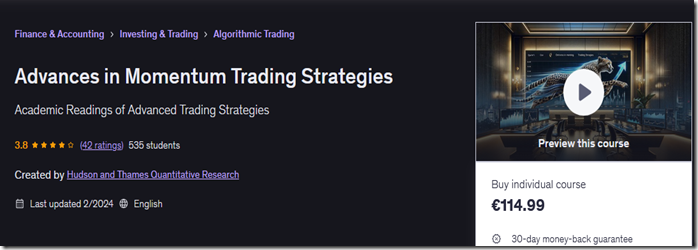
Why Momentum Is the Most Persistent Anomaly in Finance — and How to Trade It
Academic research has consistently shown that momentum — the tendency of assets that have performed well to continue performing well — is one of the most persistent anomalies in finance. Stocks that have outperformed over the past 3-12 months tend to continue outperforming, and stocks that have underperformed tend to continue underperforming. This isn’t theory — it’s been documented across decades, markets, and asset classes. The traders who understand and exploit momentum have a significant edge.
Advances in Momentum Trading Strategies is a research-backed course that teaches you the latest momentum strategies — from traditional price momentum to factor-based momentum to time-series momentum.
Inside Advances in Momentum Trading Strategies
Module 1: Momentum Fundamentals
- What Is Momentum: Understanding momentum — why it exists, why it persists, and the academic evidence behind it.
- Types of Momentum: The different types of momentum — cross-sectional (relative), time-series (absolute), and factor momentum.
- Momentum Anomalies: Why momentum works — behavioral finance explanations, risk-based explanations, and structural explanations.
- Momentum Crashes: Understanding momentum crashes — when they happen, why they happen, and how to protect against them.
Module 2: Cross-Sectional Momentum
- Relative Strength: How to rank assets by relative strength and trade the winners — the classic momentum strategy.
- Formation Period: How to choose the optimal formation period — 3-month, 6-month, and 12-month momentum.
- Holding Period: How long to hold momentum positions — rebalancing frequency and transaction costs.
- Sector Momentum: How to apply momentum within sectors — rotating into the strongest sectors and out of the weakest.
Module 3: Time-Series Momentum
- Trend Following: How to use moving averages and trend indicators to trade time-series momentum — the foundation of CTA strategies.
- Breakout Strategies: How to trade breakouts from ranges — Donchian channels, Bollinger breakouts, and volatility breakouts.
- Multi-Asset: How to apply time-series momentum across asset classes — equities, bonds, commodities, and currencies.
- Volatility Targeting: How to use volatility targeting to normalize returns across assets — risk parity and equal volatility weighting.
Module 4: Advanced Momentum
- Factor Momentum: How to trade momentum within factors — value, quality, low volatility, and size momentum.
- Momentum Quality: How to combine momentum with quality filters — earnings momentum, profitability momentum, and fundamental momentum.
- Dynamic Momentum: How to adapt momentum strategies to market regimes — bull, bear, and sideways markets.
- International Momentum: How to apply momentum strategies across international markets — developed, emerging, and frontier.
Module 5: Risk Management
- Portfolio Construction: How to construct a momentum portfolio — position sizing, diversification, and correlation.
- Drawdown Management: How to manage momentum drawdowns — stop losses, hedging, and tactical allocation.
- Transaction Costs: How to account for transaction costs in momentum strategies — rebalancing frequency and execution.
- Backtesting: How to backtest momentum strategies properly — avoiding look-ahead bias, survivorship bias, and overfitting.
What Makes This Course Different?
1. Research-Backed. Every strategy is backed by academic research — not anecdotal evidence or marketing claims.
2. Comprehensive. Covers cross-sectional, time-series, and factor momentum — the full spectrum of momentum strategies.
3>Practical. Includes specific rules, parameters, and backtesting results you can implement immediately.
Who Should Take This Course?
Perfect For:
- Quantitative traders who want to add momentum strategies to their toolkit.
- Systematic traders who want research-backed momentum systems.
- Portfolio managers who want to understand and exploit momentum across asset classes.
Not For:
- Beginner traders who need to learn basic chart reading first.
- Anyone who prefers discretionary trading over systematic approaches.
Final Verdict
Momentum is the most persistent anomaly in finance — and it’s been documented across decades, markets, and asset classes. Advances in Momentum Trading Strategies teaches you the latest research-backed momentum strategies — cross-sectional, time-series, and factor momentum — with specific rules you can implement. If you want to exploit one of the most well-documented edges in trading, this course provides the research and the rules.